Technical Skills in Action

Data Analysis

Built an interactive Power BI scorecard to evaluate sales representative performance across revenue attainment and discount behavior. The dashboard assigns composite scores, classifies representatives into risk tiers, and surfaces coaching priorities for leadership — identifying two at-risk representatives whose pricing behavior was flagging margin risk that would not have been visible through standard reporting.

Sales Team Performance Scorecard
November 2025  ·  Sales Operations Analysis
Power BI
Team Avg Score
74.6
▲ 3.1 vs prior month
Green Zone
4
Representatives
At Risk
2
Action required
Avg Discount Rate
11.4%
▲ Above target
Representative Performance
Rep Composite Score Discount % Tier
Alice
91.2
7.1% Green
Bob
85.0
8.4% Green
Carol
79.4
9.2% Green
Frank
76.1
10.0% Green
David
69.2
14.8% Watch
Eve
63.6
17.3% High Risk
Tier Distribution
6
Reps
Green Zone 4 reps
Watch Zone 1 rep
High Risk 1 rep
Recommendation
Enroll Eve and David in targeted pricing discipline training to address above-average discount behavior and recover margin risk.
Score vs Discount Rate Comparison
91.2
Alice
85.0
Bob
79.4
Carol
76.1
Frank
69.2
David
63.6
Eve

Designed and implemented a Power BI dashboard to analyze user feedback collected during a critical enterprise application migration. By visualizing satisfaction across performance and experience dimensions, the dashboard pinpointed a server capacity constraint at the root of 68% of complaints — directly informing the technical team's infrastructure decisions and accelerating resolution before the issue could compound.

Application Migration Survey Results
April 2025  ·  User Experience & System Performance Analysis
Power BI
Total Responses
342
▲ 89% response rate
Satisfied with Migration
61%
Below 75% target
Reported Performance Issues
38%
Concentrated 9–11am
Issues Resolved Post-Fix
94%
After server upgrade
Satisfaction by Category
Data Accuracy
82%
82%
UI / Navigation
74%
74%
Feature Parity
68%
68%
System Performance
44%
44%
Load Time
39%
39%
Support Responsiveness
71%
71%
Performance Complaints by Hour of Day
Peak: 10am 7am 9am 10am 12pm 2pm 4pm
Finding: 68% of performance complaints occurred between 9–11am, indicating a server capacity constraint at peak usage — not a systemic failure.
Key Insights & Actions Taken
Root Cause
Server capacity insufficient for concurrent peak-hour usage during migration window
Action Taken
Technical team upgraded server infrastructure based on dashboard findings within 72 hours
Outcome
94% of reported issues resolved post-fix; satisfaction score recovered to 78% in follow-up survey

Analyzed employee training completion rates and post-training performance scores across eight departments to determine whether the organization's training investment was producing measurable results. Using Excel pivot tables, conditional formatting, and annotated charts, the analysis revealed a clear threshold effect: departments above 80% completion showed an average 15% performance improvement, while those below 60% showed no meaningful change — providing a data-backed case for mandatory completion standards.

Employee Training Effectiveness Analysis
Academic Project  ·  UMGC  ·  Data Analysis & Visualization
Excel
Summary Dashboard
Department Data Pivot Tables Charts
Departments Analyzed
8
Across 3 divisions
Employees in Dataset
214
Training participants
High Completion Avg Score Δ
+15%
Completion rate ≥80%
Low Completion Avg Score Δ
~0%
Completion rate <60%
Completion Rate vs Score Improvement
Score Improvement %
A
B
C
D
E
F
G
H
80% threshold
Completion Rate (%)
▲ Key Insight: Departments with ≥80% completion rate showed an average +15% score improvement. Those below 60% showed no statistically meaningful change — supporting a mandatory completion threshold policy.
Department Breakdown
Dept Completion Rate Score Δ
Operations
92% +18%
Compliance
88% +16%
IT Support
84% +14%
Finance
81% +12%
Logistics
67% +6%
HR
62% +4%
Marketing
48% +1%
Admin
41% 0%

Technical Guides

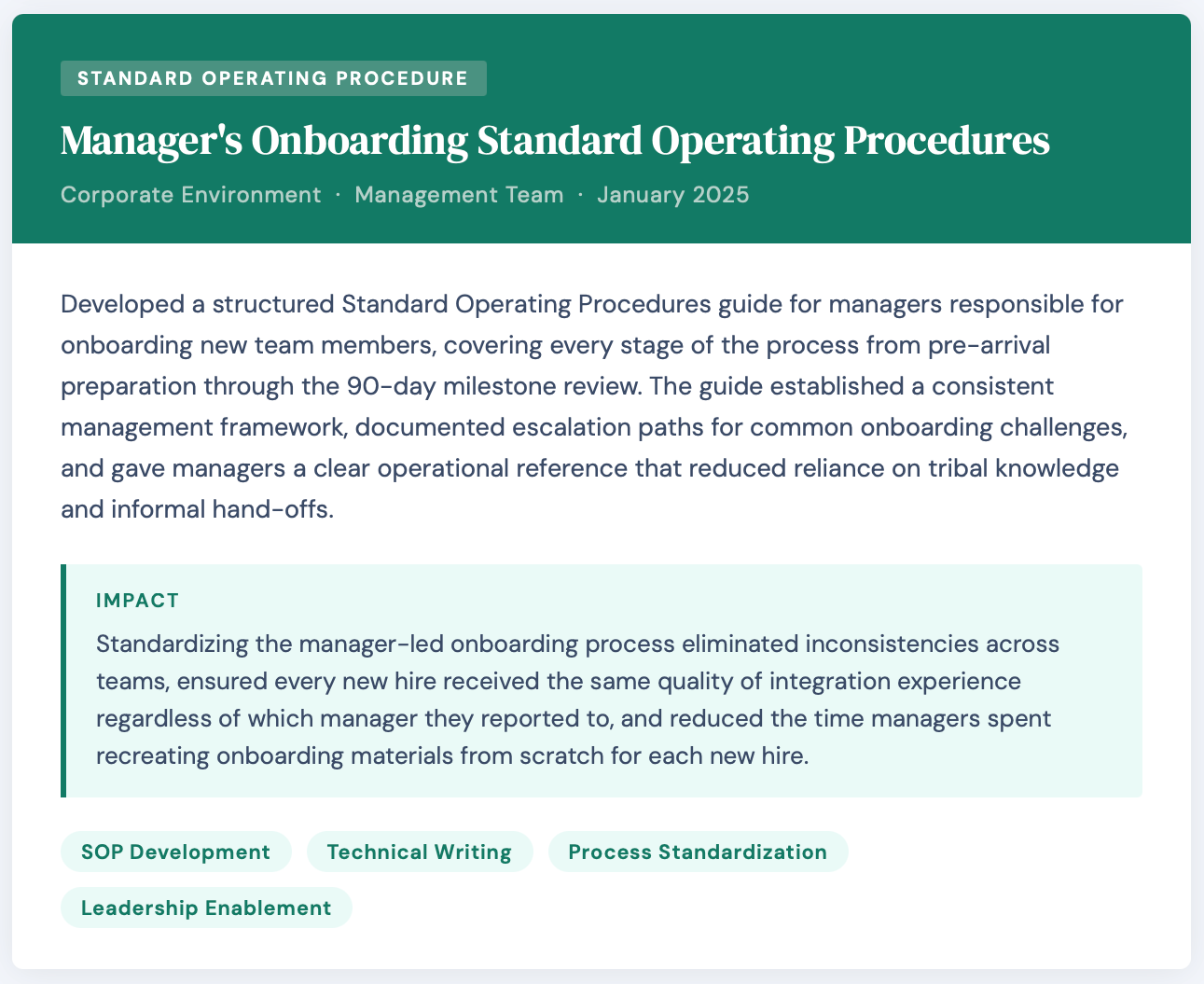
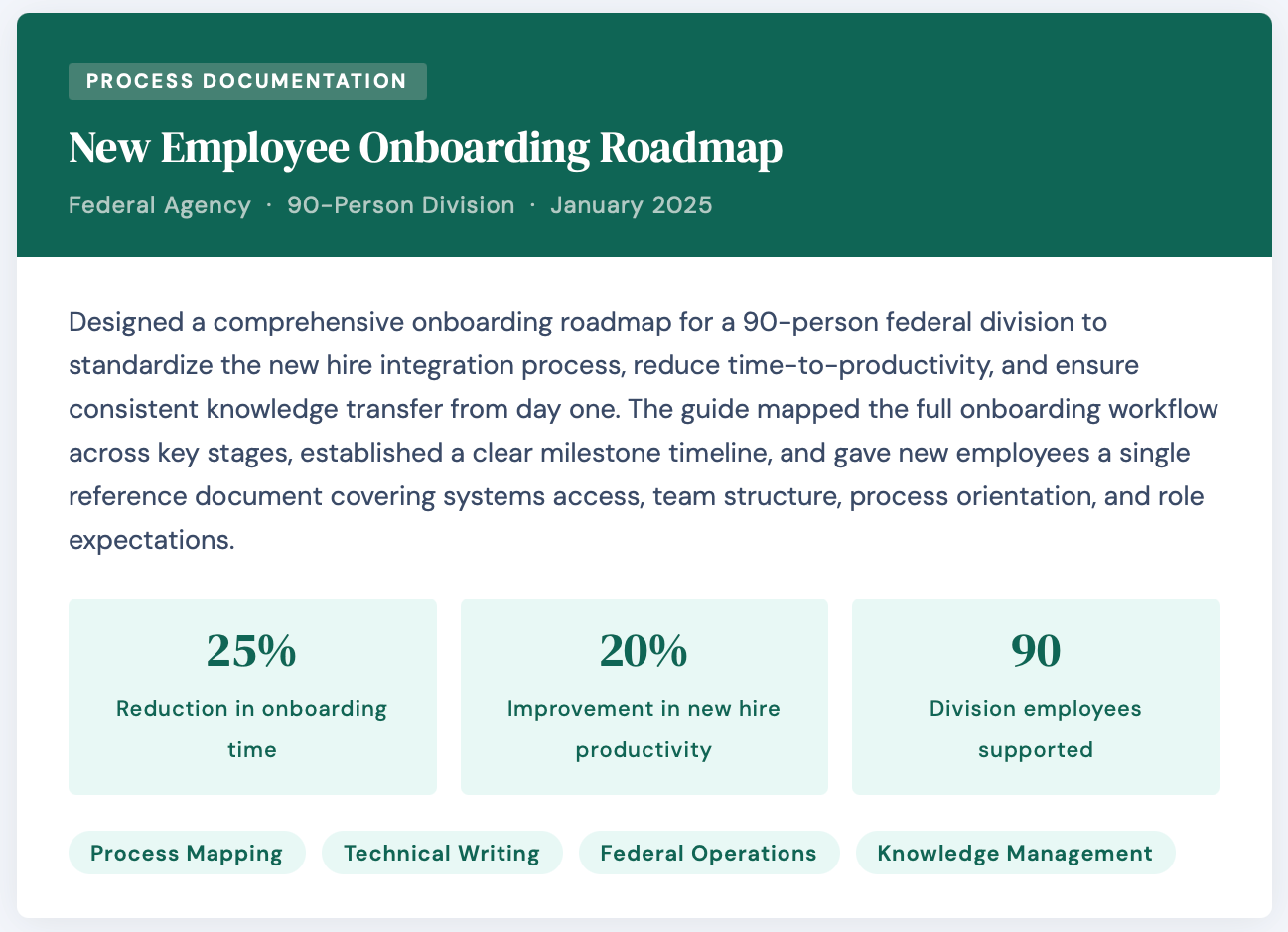
Process documentation and standard operating procedures developed across federal and corporate environments, demonstrating technical writing, workflow design, and operational standardization.

Infographics

Led the end-to-end product development of an internal workflow system for a federal agency division with no prior digital infrastructure — moving from problem discovery through requirements definition, phased build, and division-wide adoption. Treating three distinct user groups as the product's customers, I defined success metrics upfront, managed a prioritized feature roadmap across three delivery phases, and drove change management through stakeholder walkthroughs at each stage. The system served over 200 customers in its first year and reduced cross-departmental cycle times by 75%.

Product Management Case Study
Customer Service Request Management System
Federal Agency  ·  Internal Workflow Product  ·  2022–2023
3
User Groups
Division Staff
Need a structured, trackable way to submit service requests without relying on email or phone
Team Leads
Need clear ownership and automatic routing so requests reach the right person without manual forwarding
Division Leadership
Need real-time visibility into request volume, resolution times, and team workload for resource planning
01
Structured Intake Form
02
Auto-Routing by Type
03
Real-Time Status Visibility
04
Compliance Audit Trail
05
Leadership Dashboard
Phase 01
Foundation
SharePoint divisional site build
Structured intake form design
Request tracking list setup
SharePoint
Phase 02
Automation
Auto-classification pipeline
Routing to correct team owner
Escalation triggers for overdue items
Power Automate
Phase 03
Reporting
Volume and cycle time dashboard
Leadership reporting layer
Full audit trail for compliance
Power BI
200+
Customers served in year one
75%
Reduction in cycle times
3
Phases delivered on roadmap
100%
Division-wide adoption achieved

SQL Project

Developed a multi-table SQL query set against a simulated HR operations database to answer a precise business question: which training programs deliver the strongest return on investment when measured against post-training performance improvement and 12-month retention rates? The analysis joins four relational tables, applies aggregation and ROI indexing logic, and surfaces a key finding — programs with structured pre and post assessments produced 2.3 times higher ROI scores than those without, regardless of cost or duration, pointing to measurement design as the primary driver of training effectiveness.

SQL Training ROI Analysis
training_roi_analysis.sql
HR Operations Dataset  ·  Employee Training ROI Analysis
SQL
query.sql schema.sql results.csv
// training_roi_analysis.sql
-- Training ROI Analysis
-- Performance improvement by program

SELECT
  t.program_name,
  t.department,
  COUNT(tc.employee_id)
    AS total_completions,
  ROUND(AVG(tc.completion_rate),1)
    AS avg_completion_pct,
  ROUND(AVG(
    ps.post_score - ps.pre_score),1)
    AS avg_score_improvement,
  ROUND(AVG(r.retained_12mo)*100,1)
    AS retention_rate_pct,
  ROUND(AVG(ps.post_score-ps.pre_score)
    / NULLIF(AVG(t.cost_per_employee),0)
    * 100, 2)
    AS roi_index

FROM training_programs t
JOIN training_completions tc
  ON t.program_id = tc.program_id
JOIN performance_scores ps
  ON tc.employee_id = ps.employee_id
  AND ps.review_period
    = 'post_training'
JOIN retention_data r
  ON tc.employee_id = r.employee_id

WHERE tc.completion_date
  BETWEEN '2023-01-01'
  AND '2024-12-31'
  AND tc.completion_rate >= 0.75

GROUP BY
  t.program_name, t.department
HAVING COUNT(tc.employee_id) >= 10
ORDER BY roi_index DESC
LIMIT 10;
// query results — 7 rows returned
# Program Dept Score Δ ROI Index
1 Assessed PM Cert Operations +19.2
4.82
2 Data Analysis w/ Pre/Post IT Support +17.8
4.41
3 Compliance Fundamentals Compliance +15.4
3.91
4 Leadership Essentials Finance +13.1
3.28
5 Onboarding (No Assess.) HR +5.2
1.52
6 Generic Orientation Admin +2.1
0.66
7 Video-Only Module Marketing +0.8
0.21
✓ Query executed in 0.043s  ·  7 rows returned  ·  4 tables joined
Key Finding
Programs with structured pre/post assessments scored 2.3x higher ROI than those without — regardless of cost or duration
Technique Used
3-table JOIN across training completions, performance scores, and retention data with HAVING filter for statistical validity
Recommendation
Require pre/post assessments for all programs above $500/employee to maximize measurable training ROI
Product Management Case Study
Customer Service Request Management System
Federal Agency  ·  Internal Workflow Product  ·  2022–2023
3
User Groups
📋
Division Staff
Need a structured, trackable way to submit service requests without relying on email or phone
👥
Team Leads
Need clear ownership and automatic routing so requests reach the right person without manual forwarding
📊
Division Leadership
Need real-time visibility into request volume, resolution times, and team workload for resource planning
01
Structured Intake Form
02
Auto-Routing by Type
03
Real-Time Status Visibility
04
Compliance Audit Trail
05
Leadership Dashboard
Phase 01
Foundation
SharePoint divisional site build
Structured intake form design
Request tracking list setup
SharePoint
Phase 02
Automation
Auto-classification pipeline
Routing to correct team owner
Escalation triggers for overdue items
Power Automate
Phase 03
Reporting
Volume and cycle time dashboard
Leadership reporting layer
Full audit trail for compliance
Power BI
200+
Customers served in year one
75%
Reduction in cycle times
3
Phases delivered on roadmap
100%
Division-wide adoption achieved